-
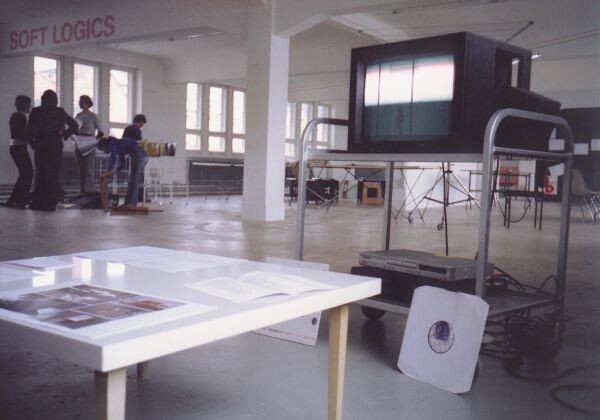
exhibition view -
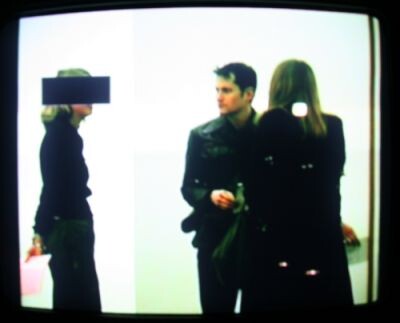
video (detail)
Künstlerhaus Stuttgart
Reuchlinstr. 48
70178 Stuttgart
Soft Logics
Rahel Puffert presents A Visit to Nagel's
In general, art mediation work is committed to emancipatory goals. For example, it aims to increase access opportunities, engage excluded groups, expand the field of those who participate in art, and encourage creative uses of art. In recent decades, the efforts of art and museum educators, as well as many artists, have primarily focused on seeking contact with "neglected" target groups and developing languages and methods that can establish a relationship with art.
Often, one faces the task of “translating” the official, legitimate language reserved mainly for specialists into a form accessible to an audience that does not belong to the “insiders.” This is a Sisyphean endeavor, as it tends to involve breaking down barriers that are repeatedly constructed by discourse to safeguard knowledge reserved for certain elites, which contributes to the (economic) valuation of art. In fact, it must be noted repeatedly that the concept of art mediation understood democratically is not shared by all participants in the art system. The following quote may illustrate this:
“The function of gallery owners can also be seen in their role of relieving artists from the (partially diffuse and contradictory) expectations of these various groups. Artists can fully concentrate on the process of creating art and only participate in the general life of the art audience during an exhibition opening. Above all, the artist is relieved of the burden of having to constantly interpret their art to laypeople. This role is primarily left to the gallery owner in personal conversations, who consequently holds the greatest interpretive power over the art among all the groups mentioned.”*
In light of such statements, a dual strategy seems advisable to me: alongside working on collective, participatory, or interactive mediation offerings, I find it equally relevant to explore opposing concepts of mediation, as well as strategies, places, and mechanisms that stand in contrast to a work oriented toward openness and transparency.
Together with Michel Chevalier, I visited the Berlin branch of the internationally renowned Gallery Nagel at Rosa-Luxemburg-Platz in 2003. We engaged the gallery assistant in a conversation to learn more about the background of the exhibition by Michael Krebber on display there. What was the significance of the term “PopPolitics” on the invitation card? And how could the references to Russian Constructivism be interpreted? How did the very sparsely distributed objects on the walls (record covers, newspaper, CD, airmail stickers) relate to one another? The first piece of information we received was that the artist had explicitly refused any form of written explanation for his exhibition.... A clandestine recording of this conversation can be seen in a video: “A Visit to Nagel’s”
–Rahel Puffert
* Heine von Alemann: Galerien als Gatekeeper des Kunstmarkts. Institutionelle Aspekte der Kunstvermittlung, in: Jürgen Gerhards (Ed.): Soziologie der Kunst (Opladen, 1997), p. 221